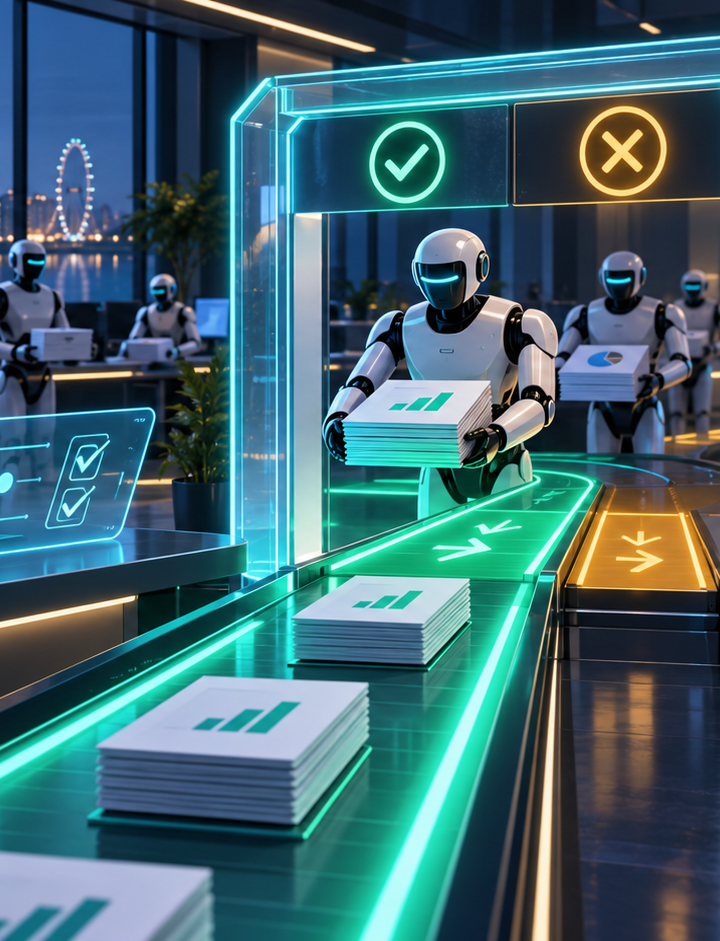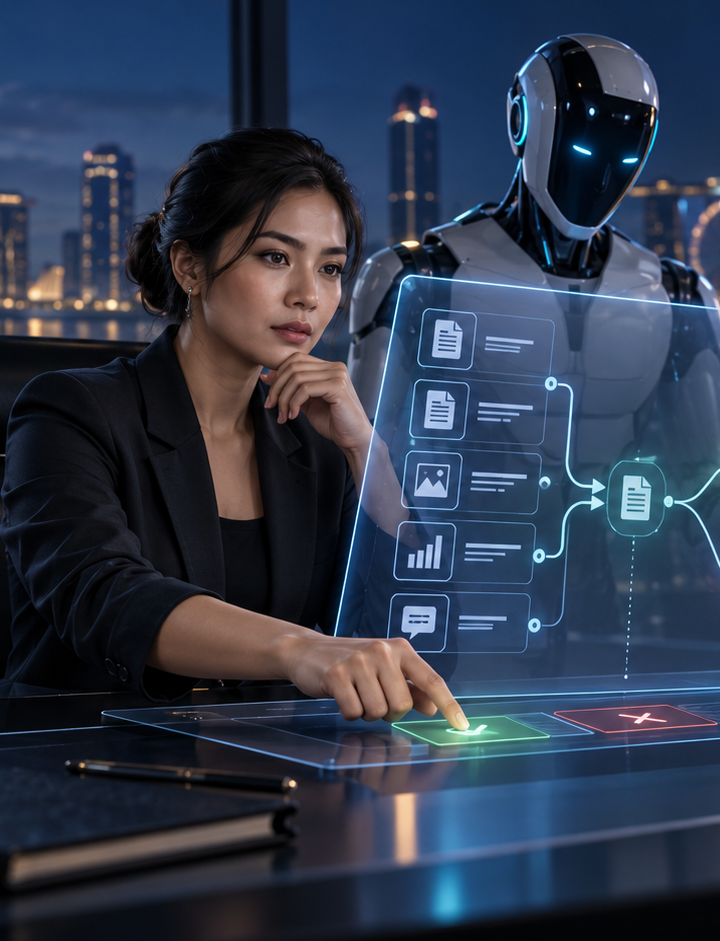
Multi-agent AI systems are transforming how we solve complex problems. Here's what you need to know:

- Multiple AI agents work together, each with specific roles
- They share information and divide tasks for faster, more efficient problem-solving
- Already used in smart power grids, disaster rescue, and manufacturing
- Market expected to grow from $4.8 billion in 2023 to $28.5 billion by 2028
Key benefits of multi-agent AI:
| Benefit | Description |
|---|---|
| Smarter problem-solving | Agents combine knowledge and skills |
| Increased speed | Tasks run in parallel |
| Adaptability | Easy to add or swap agents as needed |
| Reliability | System continues if one agent fails |
Challenges include coordination issues, information overload, and ethical concerns. Despite these, multi-agent AI is set to revolutionize industries from healthcare to finance.
As Andrew Ng says: "Multi-agent LLM systems could change how we work. By combining multiple AI agents' expertise, we can tackle complex problems we thought were unsolvable."
Related video from YouTube
How Multi-Agent AI Works
Multi-agent AI is like a team of smart robots working together on tough problems. Here's how it works:
Key Ideas
- Each AI agent thinks for itself
- Agents team up for shared goals
- They talk to each other to coordinate
- The system adapts to new challenges
This setup tackles problems too big for one AI alone.
Main Parts
- Agents: Individual AIs with unique skills
- Environment: Where agents operate
- Coordination Rules: How agents work together
Here's how it fits:
| Part | Job | Example |
|---|---|---|
| Agents | Do specific tasks | Support bot knowing product details |
| Environment | Sets the scene | Simulated stock market |
| Coordination Rules | Enable teamwork | How rescue drones share info |
One vs. Many
Why use multiple agents? Let's compare:
| Feature | One Agent | Many Agents |
|---|---|---|
| Complexity | Simple | Needs coordination |
| Flexibility | Limited skills | Handles diverse tasks |
| Scalability | Fixed capacity | Grows with more agents |
| Reliability | Single point of failure | Keeps going if one fails |
Multi-agent systems excel at big, messy problems. Think disaster rescue: a drone team finds survivors faster than one alone.
"Multi-agent systems boost efficiency, reliability, flexibility, and more." - The Alan Turing Institute
It's not just theory. Companies use multi-agent AI for smart grids and efficient factories.
How AI Agents Work Together
AI agents team up to tackle tasks too complex for a single AI. Here's how they collaborate and the pros and cons of this approach.
Perks of AI Teamwork
AI teamwork offers some key advantages:
- Smarter problem-solving: Combining skills helps agents crack tough problems faster.
- Speed boost: Dividing tasks among agents gets work done quicker.
- Adaptable setup: Easy to add or swap agents as needed.
Here's a quick breakdown:
| Perk | How It Helps |
|---|---|
| Smarter problem-solving | Agents pool knowledge and skills |
| Speed boost | Tasks run side-by-side |
| Adaptable setup | New agents can join on the fly |
AI Collaboration Styles
AI agents can work together in a few ways:
- Teamwork: Agents share info and resources for a common goal.
- Competition: Agents try to outdo each other, pushing for better results.
- Mix and match: Some tasks need teamwork, others spark competition.
Take smart cities, for example. AI agents team up to manage traffic. One handles traffic light timing, another tracks traffic flow. They share data to keep things moving.
"Multi-agent LLM systems could change how we work. By combining multiple AI agents' expertise, we can tackle complex problems we thought were unsolvable." - Andrew Ng, Chief AI Officer at Landing AI and Coursera co-founder.
Bumps in the Road
AI teamwork isn't always smooth sailing:
- Coordination hiccups: Getting all agents in sync can be tricky.
- Info overload: Agents might share too much, slowing things down.
- Conflicting plans: Agents might clash over next steps.
Let's break it down:
| Problem | Cause | Fix |
|---|---|---|
| Coordination hiccups | Agents have different goals | Set clear teamwork rules |
| Info overload | Agents overshare | Limit sharing to key data |
| Conflicting plans | Agents disagree on strategy | Use a lead agent for final calls |
Real-world example: SEB, a major Swedish bank, uses an AI assistant named Aida for customer chats. Aida handles simple stuff, freeing up human workers for trickier issues. It's a prime example of AI-human teamwork, each doing what they do best.
How Multi-Agent Systems Are Built
Multi-agent systems (MAS) are networks of AI agents working together to solve problems. Here's how they're built:
Central vs. Spread-Out Systems
MAS can be centralized or decentralized:
| Feature | Centralized MAS | Decentralized MAS |
|---|---|---|
| Control | Single point | Distributed |
| Data processing | Central servers | Multiple devices |
| Scalability | Vertical (upgrade servers) | Horizontal (add nodes) |
| Resilience | Single point of failure | No single point of failure |
| Updates | Easy | Can be complex |
| Innovation | Limited | Encourages diversity |
Centralized systems are easier to manage but riskier. Decentralized systems are harder to control but more flexible.
Agent Communication
Agents need to talk. Here's how:
- Message passing: Direct info exchange
- Shared memory: Common space for reading/writing
- Publish-subscribe: Selective info reception
Agents follow rules to understand each other and avoid conflicts.
Decision Making
Agents make choices alone and together:
- Solo: Using their own logic
- Team: Sharing info and voting
- Leader-follower: One agent leads, others follow
They might switch between these methods. In a smart city traffic system, one agent could lead during rush hour, but all might vote on weekend plans.
"Multi-agent systems allow for specialization, customization, and scalability, enabling agents to be optimized for specific tasks and easily updated or swapped out." - MAS architecture research
Building a good MAS is tough. It needs planning and testing. But it can tackle problems single agents can't handle alone.
Tech That Makes Multi-Agent AI Possible
Multi-agent AI systems are changing how we tackle complex problems. Here's the tech that powers them:
Big Language Models (LLMs)
LLMs are the heart of multi-agent AI. They help agents:
- Understand and create human-like text
- Crunch massive data sets
- Make smart, context-based choices
Take Google DeepMind's SIMA. It uses LLMs to follow natural language commands in 3D games. It can drive, mine, and explore without peeking at the game's code.
Learning from Results
Multi-agent systems get smarter over time:
- They learn from their actions (reinforcement learning)
- They share knowledge and learn together (collaborative learning)
Devin, an AI software engineer by Cognition AI, shows this in action. It plans and executes complex coding tasks, learning and fixing mistakes as it goes. It even adapts to new tech on its own.
Group Intelligence
When agents work together, cool things happen:
| Benefit | What It Means |
|---|---|
| Emergent behavior | Simple agents create complex actions together |
| Specialization | Agents focus on what they do best |
| Resilience | The system keeps going even if some agents fail |
DARPA tested this with three AI agents (Alpha, Bravo, Charlie) working together to find and defuse bombs in a virtual maze. They did better as a team than any single agent could.
Multi-agent systems are now used in:
- Games (smarter NPCs)
- Video production (3D crowd scenes)
- Healthcare (personalized medicine)
- Supply chain (inventory and demand prediction)
Andrew Ng from Landing AI says:
"Multi-agent LLM systems could change how we work. By combining multiple AI agents, we can solve problems we thought were impossible."
As this tech grows, we'll see even more powerful multi-agent AI systems pop up.
sbb-itb-1ec766f
Where Multi-Agent AI Is Used
Multi-agent AI is making a big splash across industries. Here's how it's being put to work:
Industry Applications
Multi-agent AI is shaking things up in several fields:
| Industry | Application |
|---|---|
| Healthcare | Analyzing records, medical images |
| Retail | Personalizing shopping |
| Finance | Fraud detection, transaction analysis |
| Logistics | Route optimization, delivery tracking |
| Manufacturing | Predictive maintenance |
Real-World Examples
Check out these concrete cases where multi-agent AI is tackling tough problems:
1. Healthcare
IBM Watson Health sifts through medical literature and patient records to help doctors create tailored treatment plans.
2. Retail
Amazon's AI team works together to give you spot-on product recommendations based on your browsing and buying history.
3. Finance
JPMorgan Chase uses AI to flag suspicious transactions in real-time, keeping your money safer.
4. Logistics
FedEx employs smart AI sorters that team up to get packages to their destinations quickly.
5. Manufacturing
Siemens' AI predicts potential machine breakdowns, allowing for preemptive maintenance.
Future Possibilities
As AI evolves, we might see:
- AI traffic lights communicating to keep cars moving smoothly
- AI teams using sensors and drones to detect forest fires or illegal logging
- Multiple AI agents collaborating during surgeries, each handling a specific task
Udit Goenka, CEO of FirstSales.io, offers a glimpse into the future:
"We used AI Auto-GPT to build a tool that finds potential customers by spotting companies that just got seed money. It's like having a super-smart sales team that never sleeps."
As more companies jump on the bandwagon, multi-agent AI will likely pop up in unexpected places. The key? Finding the sweet spot between AI teamwork and human know-how.
Making Good Multi-Agent Systems
Want to build multi-agent AI systems that actually work? Here's how:
Building Better Systems
Focus on these when creating multi-agent AI:
- Give each agent a clear job
- Help agents share info fast
- Make sure your system can grow
Pro tip: Use a main "think" graph to control subgraphs. It's like a traffic cop for your AI's brain.
Agents with Special Skills
Give each AI agent a job that fits:
| Agent | Job | What They Do |
|---|---|---|
| Strategist | Make plans | Map out projects |
| Analyst | Crunch data | Find patterns |
| Executor | Get stuff done | Follow the plan |
This way, each agent sticks to what it's good at.
Solo vs. Team Player
Getting the right mix of alone time and teamwork is key:
1. Let agents work alone when they can.
2. Check in regularly to stay on track.
3. Have a boss agent to keep an eye on things.
Kobi Gal, who knows a lot about AI teamwork, says:
"When agents work well with humans or balance out each other's skills, they do better than going solo."
This works for all-AI teams too. Mix it up, and you'll get the best results.
Problems and Limits
Multi-agent AI systems are powerful, but they're not perfect. Here are some big challenges:
Making Systems Bigger
Scaling up isn't easy:
- More agents = more data = slower systems
- Agents struggle to communicate in large teams
- Big systems eat up computing power and storage
In 2022, OpenAI's GPT-3 used 175 billion parameters. Training took 355 GPU-years and cost millions. That's a LOT of resources.
Ethical Issues
AI teamwork raises tricky questions:
- Who's to blame when things go wrong?
- AI can learn biases, leading to unfair outcomes
- Privacy concerns with data collection and sharing
Real-world example: Amazon scrapped an AI hiring tool in 2018 because it discriminated against women. The AI learned from mostly male resumes, showing how bias can creep in.
Tech Limits
Current tech needs to catch up:
- We need faster data processing
- Some AI methods don't scale well
- It's often unclear why AI makes certain choices
| Challenge | Impact | Possible Fix |
|---|---|---|
| Data overload | Slows systems | Better compression |
| Communication issues | Less efficient | Improved networking |
| Resource demands | Higher costs | Smarter algorithms |
| Ethical concerns | Less trust | Stricter AI rules |
| Tech limitations | Slows progress | More R&D |
These aren't deal-breakers, but they show where multi-agent AI needs work. Researchers and developers are tackling these issues head-on.
What's Next for Multi-Agent AI
Multi-agent AI is changing fast. Here's what's coming:
New Trends
Specialized agents: Companies are building AI teams with specific skills. Regie AI got $20.8 million for "auto-pilot sales agents" that find leads and write emails.
Human-AI teamwork: Businesses want AI that works WITH people, not INSTEAD of them. This makes problem-solving better.
Multimodal interaction: Agents are learning to use different types of data together (text, images, speech).
Big Changes on the Horizon
Universal AI assistants: OpenAI and Google are working on AI for everyday tasks.
AI-powered software: Future apps might use AI teams to do complex jobs automatically.
AI marketplaces: We might see online stores to "hire" AI agents for specific tasks.
How It Might Change Things
Multi-agent AI could shake up industries:
| Industry | Possible Impact |
|---|---|
| Manufacturing | AI teams running "speed factories" for custom products |
| Healthcare | AI agents teaming up to diagnose diseases and plan treatments |
| Customer Service | Multiple AI agents handling complex issues smoothly |
Jobs: AI might create 97 million new jobs by 2030. But you'll need to know how to work with AI.
Money: AI could add $15.7 trillion to the global economy by 2030.
Ethics: As AI gets stronger, we need clear rules. The European Commission president said: "AI must serve people, and therefore, AI must always comply with people's rights."
The future of multi-agent AI looks bright, but it's not simple. Everyone needs to work together to make sure this tech helps society as a whole.
Conclusion
Multi-agent AI systems are reshaping business operations and problem-solving. These systems use AI teams to tackle complex tasks.
Here's what you need to know:
- AI teams handle bigger jobs than single AIs
- Companies already use multi-agent AI (NASA, Hughes Network Systems)
- It's growing fast: 10% use it now, over half plan to start soon
- Best results come from AI-human teamwork
To use multi-agent AI:
1. Start small
Pick one area like customer service or data analysis.
2. Build gradually
Add AI agents slowly to your processes.
3. Train your team
Help employees work with AI tools.
4. Keep humans in control
Use AI to assist, not replace, human judgment.
Multi-agent AI is a game-changer. It boosts speed, smarts, and efficiency. But it's not about replacing people. It's about creating powerful human-AI teams to solve problems in new ways.