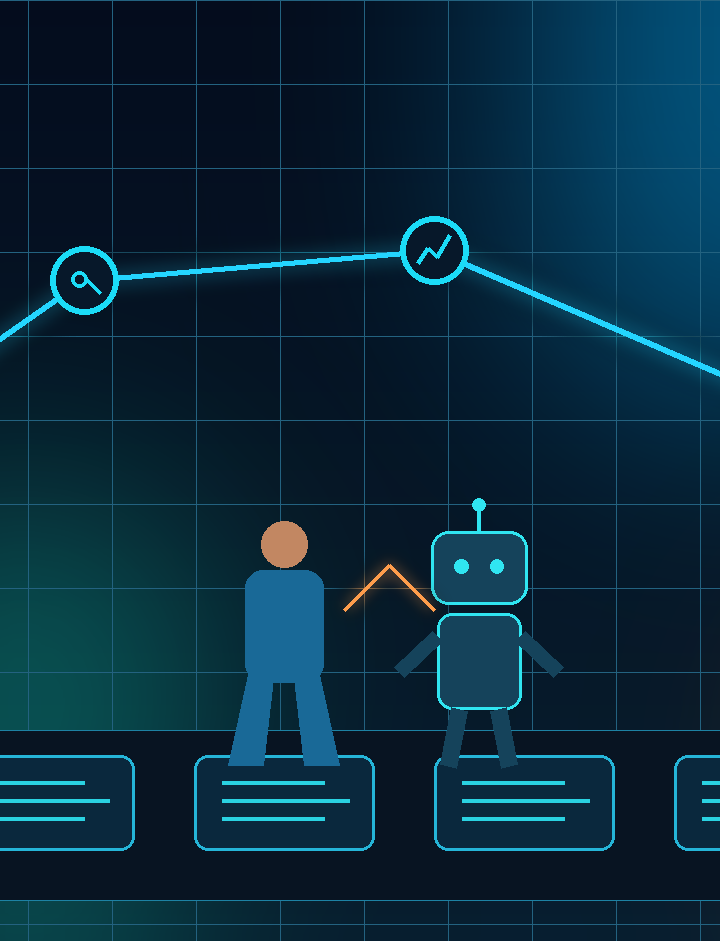
AI agents are moving out of the chat box and into execution surfaces.
That sounds like progress. It is. But for SMEs, it also changes the risk profile. A chatbot that gives a weak answer wastes time. A digital coworker that touches CRM records, invoices, support tickets, campaign assets, or internal documents can create operational mess if the company has no control plane.
The repeated signal this week is clear: vendors are pushing agents closer to real work. OpenAI’s ChatGPT agent positioning points toward systems that can browse, use tools, and complete multi-step tasks. Anthropic’s computer-use work shows AI operating software through a screen. Google’s Gemini Enterprise and Agentspace direction puts agents around enterprise search, workflows, and internal knowledge. Microsoft’s frontier-firm framing pushes the same idea inside Microsoft 365: AI is becoming a work layer, not just a writing assistant.
The operator takeaway is not “buy more agents.” It is: build the operating layer before agents start acting.
The implementation problem is no longer access to AI
Most SMEs already have access to capable AI tools. The constraint is not whether an agent can draft, search, summarise, or prepare work. The constraint is whether the business knows what the agent is allowed to do, which data it can trust, when a human must approve, and how exceptions are recorded.
That is why agentic AI consulting for SMEs has to start with workflow control, not tool demos. Without a control plane, every successful pilot becomes a fragile one-off. One team uses AI for sales notes. Another uses it for finance follow-up. Another uses it for marketing research. Nobody can see the operating risk across the company.
What an SME control plane should define
A practical agent control plane does not need to be complex. It needs to make execution visible and governable.
- Workflow map: the trigger, inputs, systems touched, decisions, handoffs, owner, and final output.
- Context boundary: which documents, records, policies, examples, and definitions the agent can use.
- Permission level: whether the agent can read, recommend, prepare, update, send, escalate, or stop.
- Approval gate: where human review is mandatory before customer, financial, legal, HR, or public-facing action.
- Telemetry: cycle time, correction rate, approval rate, exception rate, cost per workflow, and failure reasons.
- Audit trail: source inputs, tool actions, generated output, approver, timestamp, and override notes.
- Rollback rule: what happens when an agent updates the wrong record, drafts the wrong commitment, or uses stale data.
This is the difference between operating AI and orchestrating AI. Operators keep prompting. Orchestrators design the conditions under which digital coworkers can safely produce work.
Where SMEs should start
Do not start with the biggest, riskiest process. Start with one recurring workflow where the output is useful but the downside is controllable.
Good starting points include weekly sales brief preparation, support-ticket classification, internal policy Q&A with citations, invoice follow-up drafts, meeting-to-action summaries, campaign research packs, or operations exception lists.
For each workflow, classify the agent’s role:
- Read: inspect approved sources only.
- Recommend: propose the next action with reasons and evidence.
- Prepare: draft the email, update, report, or record change.
- Ask: request human approval before external or high-risk action.
- Act: execute only low-risk, reversible steps.
- Stop: escalate when data is missing, instructions conflict, or risk is unclear.
Most SMEs should spend more time in read, recommend, prepare, ask, and stop before giving agents broad act permissions.
The measurable business case
AI workflow automation for SMEs only earns trust when it can be measured. The dashboard should not only report time saved. It should show whether the work became safer, faster, and more consistent.
Track five numbers per workflow: time from trigger to draft, percentage approved without correction, percentage requiring human rewrite, number of exceptions, and cost per completed workflow. If those numbers improve while auditability remains intact, the agent is creating operating value. If they do not, the business has a supervision or context problem, not an AI hype problem.
The Nexius view
The next phase of agentic AI adoption is not about replacing staff with autonomous tools. It is about turning domain experts into AI architects.
Your best operations manager knows where work breaks. Your finance lead knows which commitments are risky. Your sales lead knows which customer context matters. Your HR lead knows where human judgment is non-negotiable. Those people should design the agent boundaries, not merely consume AI output.
That is the practical path from chat to execution: map the workflow, define the controls, instrument the work, and keep humans in the loop where judgment matters.
Orchestrate, don’t operate. Let agents do more execution only after the business has made the work visible, measurable, and governable.